Elevating Katas
Structured routines that turn organizational design intent into lived behavior
About Elevating Katas
The term kata comes from martial arts, where it describes a practiced sequence used to build skill and judgment through repetition.
In Org Topologies, Elevating Katas serve the same purpose: they provide a practical way to evolve an organization deliberately, without relying on one-off transformations or wholesale reorganizations.
The 10X Org principles set direction. They clarify what matters and what trade-offs are being made. The Katas make that direction actionable.
Rather than prescribing best practices, Katas create safe, repeatable ways to reshape structure, mandates, roles, processes, and incentives—while learning from real work.
Elevating Katas are problem-driven, not methodology-driven. Each Kata targets a specific organizational constraint and builds capability through use and reflection.
The Elevation Journey
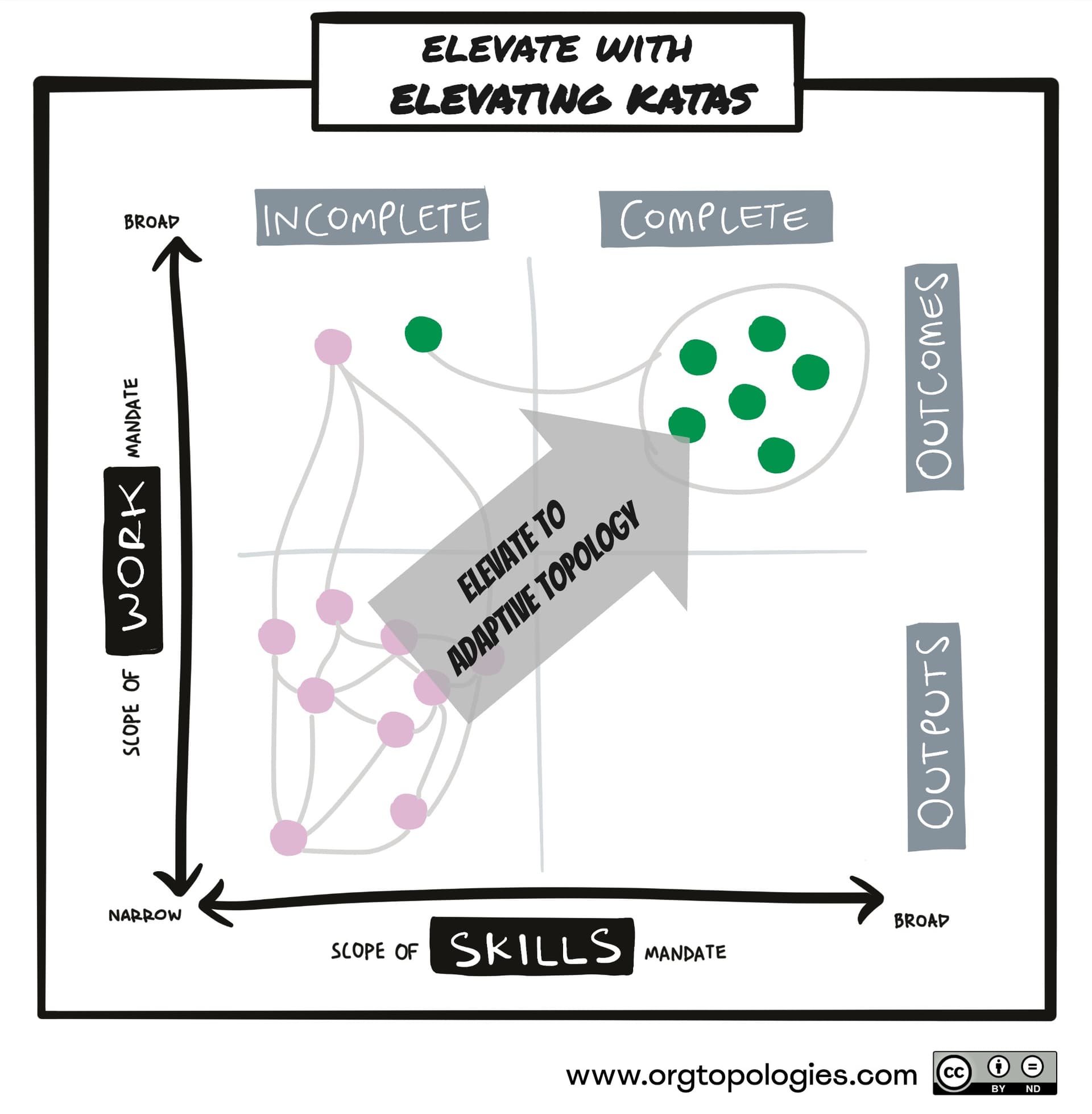
Elevating Katas help move an organization toward the top-right corner of the Org Topologies map—where teams have both broad skills mandate and broad work mandate.
This is where organizations shift from delivering outputs to delivering outcomes—from fragmented component teams to complete, whole-product teams.
The journey involves moving from narrow, specialized teams (bottom-left) through deliberate elevation to versatile, outcome-oriented teams of teams (top-right).
Katalog
The most powerful and commonly applied Elevating Katas, organized by the dimension of organizational design they address.
1. Strategy
Direction and Goals
2. Structure
Power, Authority, Organization
3. Processes
Information and Decision Flows
4. Rewards
Incentives and Motivation
5. People
Skills, Mindsets, Capabilities
Case Studies
Real-world examples of Elevating Katas in action. See how organizations have transformed their structures and outcomes.
Poster
Ukrainian SaaS Company
The CEO gave employees 90 days to learn systems thinking and organizational design. They co-created a better future state together.
Katas Applied
The change built real adaptiveness through COVID-19 and war—back to profitability within a year.
Read Full Case StudyStrobbo
Belgian HR-Tech Company
Strobbo's agile journey focused on reducing coordination load and decision bottlenecks by reshaping how work is organized, prioritized, and integrated across teams—progressing from team-level delivery toward product-level flow.
Katas Applied
The change shifted teams from constrained agility with dependency bottlenecks to shared direction, continuous integration, and outcome-driven steering.
Read Full Case StudyEV Charging
Scale-up in a Dynamic Market, Netherlands
An EV scale-up moved from component silos with heavy dependencies to end-to-end teams organized as a team-of-teams. They stabilized the flip with merged backlogs, multi-team refinement, shared cadence/DoD, shared ownership, synchronous teamwork, and team self-design.
Katas Applied
The flip delivered faster time-to-market and smoother flow by reducing cross-team handoffs and bottlenecks—through shared prioritization, cadence, ownership, and “done” standards across end-to-end teams.
Read Full Case Study
Ready to Transform Your Organization?
Elevating Katas are part of the comprehensive framework in the 10X Org book. Start your elevation journey today.